With many thanks to Stuart (“Goonery“) … proof that it even snows at the MINI Oxford factory in England!

Snow at Plant Oxford in England
With many thanks to Stuart (“Goonery“) … proof that it even snows at the MINI Oxford factory in England!
When I was in California last month, I was working with CMEC on a couple of brand new prototype machines, which they are showing this week at the show World Of Concrete.
My colleague Josh spotted a news write-up this morning, so now that these machines are officially published, I can borrow a couple of the news pics to show you what I was doing!

The machine pictured here is CMEC’s “sigma level”, very much inspired by competitor Upright’s “speed level“, put on the market more than 10 years ago! The interesting thing is that when this machine was created, Upright was located at the CMEC facility in Selma, CA – and some of the people working at CMEC now, also worked on the Upright machine … I’m not saying it’s a clone, but there’s certainly a lot of similarities!
The big difference between the new CMEC and old Upright machines, of course, is that the new machine has our PG Trionic control system – so it’s bound to work much better 🙂
Background:
A typical scissor vehicle needs to be on relatively flat ground before it can lift (maybe less than 3 degree slope); otherwise it risks falling over! Some machines have outrigger legs which the operator can extend down, to lift the machine off the ground and level it – but outrigger leg length limits the maximum slope that the machine can be leveled on (maybe 7 degrees), and leveling is relatively slow.
The “sigma level” machine works differently, using hydraulic cylinders to push the platform arms left/right and up/down, so that the platform is level even while the chassis and wheels remain on the sloping ground – this gives a much faster leveling, and can work over a more severe slope (up to 15 degrees!)
Hopefully CMEC will be successful with this new machine, bringing PG Trionic some more business!
There’s only so many snow pictures I can post, before anyone visiting the site (if there is anyone) gets bored … but there’s not much else happening in the week, except for work, so … Here’s a couple of pictures of what I’m doing at work today!
The first picture shows the work area; in front you can see a cart, on which is mounted one of my development rigs – we mount them on carts now so I can wheel them in and out of the office according to work demands (my office isn’t big enough to leave everything set up, any more!); on the left of the cart you can see the joystick handle that on a real vehicle controls drive forward/reverse and lift up/down; it’s normally attached to the off-white box next to it (on a vehicle this box is mounted on the work platform), on which you can see a keyswitch (turns vehicle off/on), a big red emergency stop button, and some other switches (which control things like whether to drive or lift):
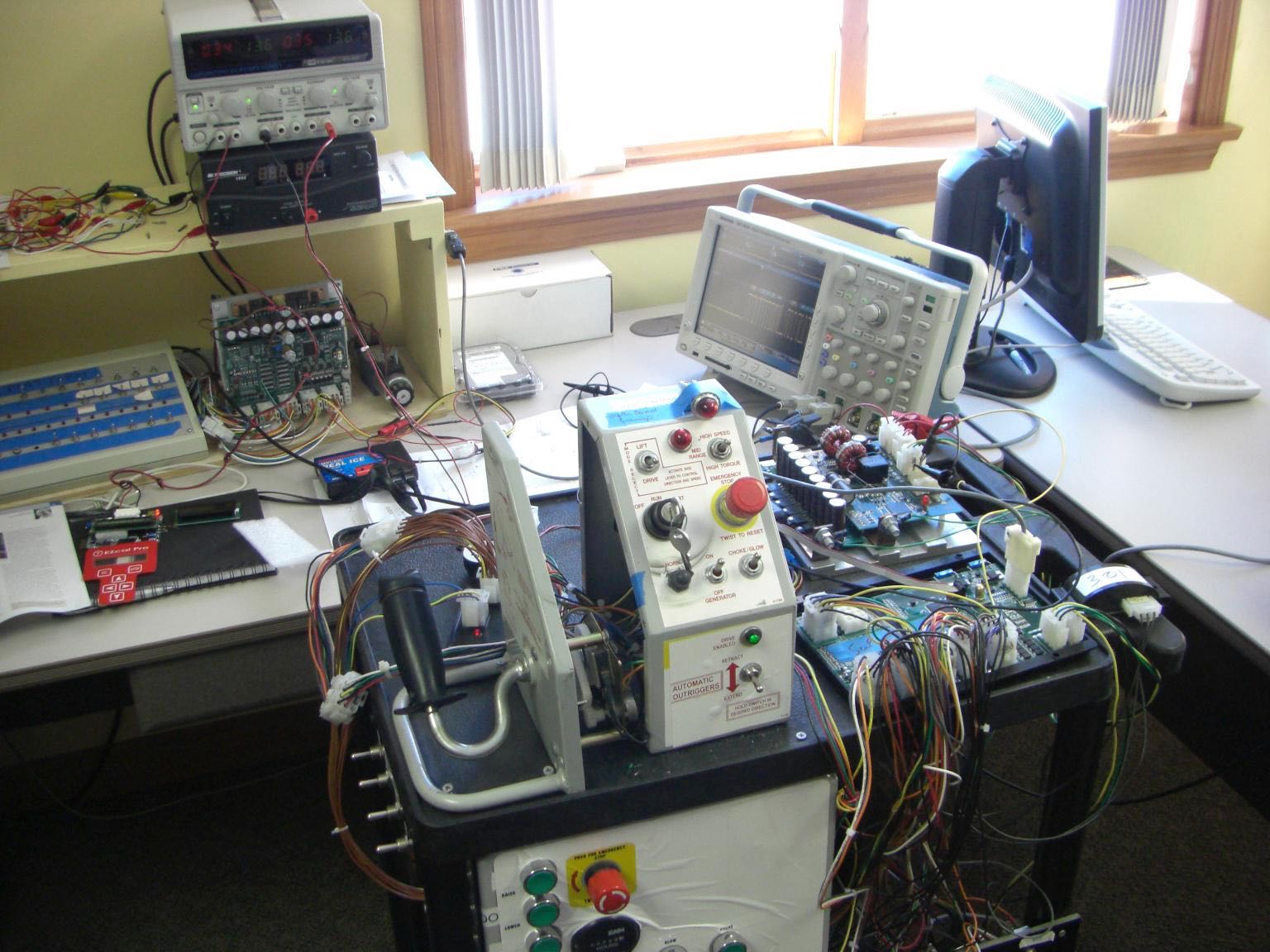
To the right of the platform control box you can see two electronic modules (and loads of wires); the back module controls high current/voltage to a hydraulic pump (up to 250A at 24V); the front module is the “brains” of the vehicle and can control up to 70 hydraulic valves, to determine where the pumped oil flows on the vehicle.
In the background, you can see another rig (with lots of blue labelled switches and lights), a couple of power supplies, and on the back right there is an oscilloscope – this expensive piece of equipment can monitor and display signals (voltages which change over time). It’s an extremely useful device, sometimes! I actually had to have one shipped out to me in California when I was working there recently – I needed it for only a couple of minutes, but could do nothing without it.
Here is a close-up of the oscilloscope:
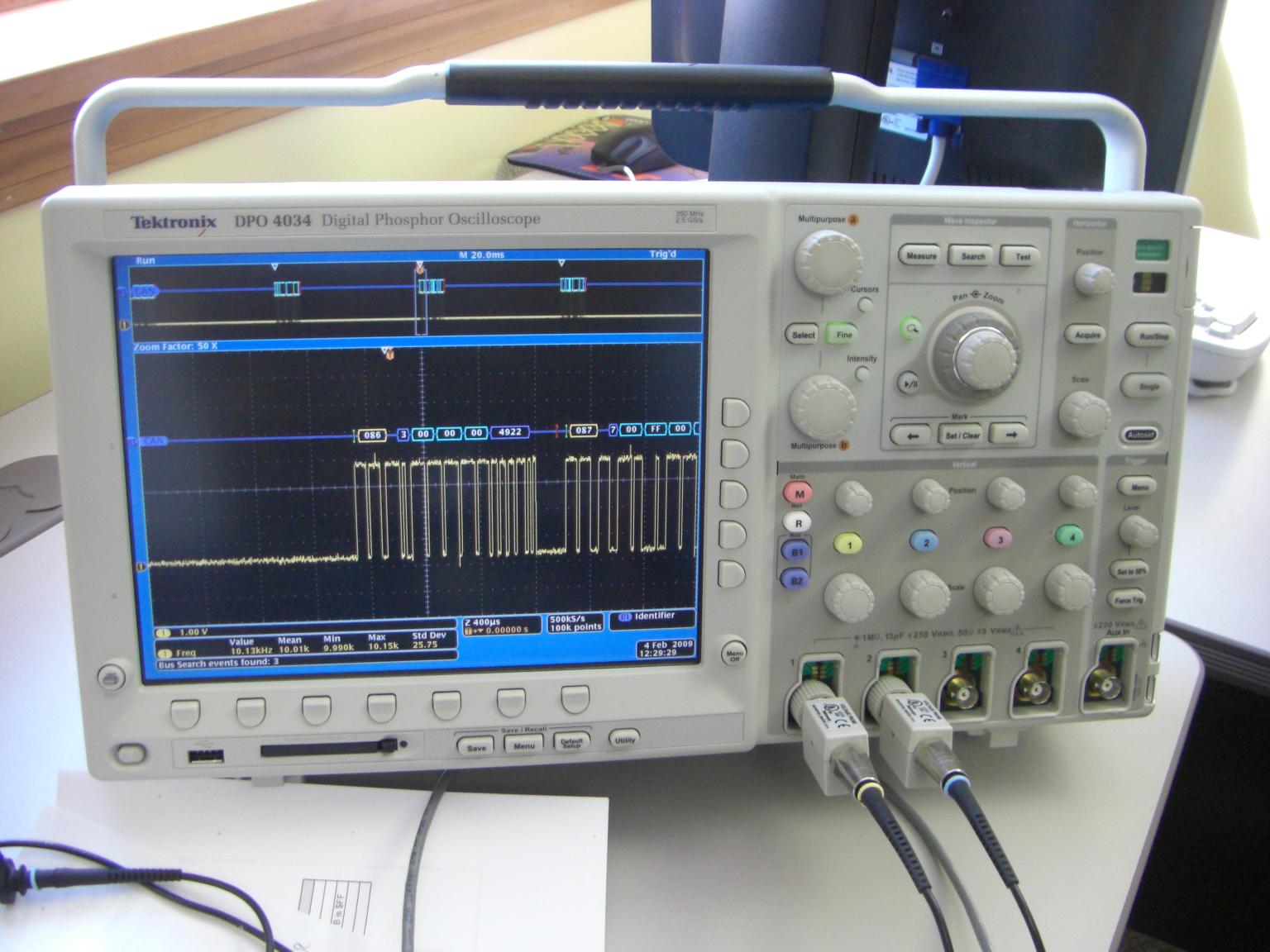
The display is showing, at the top, a relatively long time of a voltage signal, below is a zoomed in part – the actual signal is shown in yellow, and above it the ‘scope is smart enough to decode the meaning; this signal is a CANbus which transmits data pulse by pulse at 50KHz (50,000 bits of data per second); the ‘scope shows a message with identifier 086, followed by 3 (the number of bytes of data), then the actual data (00, 00, 00) and finally a message checksum (which is used to ensure receipt of the data without error). After that you can see part of another message, identifier 087.
This display enables me, in seconds, to confirm correct data being transmitted from one module to another – or to easily see where there is a problem that needs fixing. Once everything is working, I don’t need the ‘scope any more; but during early development it makes my work hundreds of times quicker / easier!
 M&I / GBMINI
