MOT2009 check presentation

Today, MINIsOnTop volunteers gathered at Michael & Pam’s house, for a bunch of “well done / thanks”, and check presentation to the Make-A-Wish Foundation of Maine, and (via Pete) the Mount Washington Observatory. James from Make-A-Wish of Maine kindly  joined us to accept the check ($10,315.82) to- and to make a “thank you” presentation to us:

We also presented the Mount Washington Observatory check ($692.18); MWO could not attend, so Pete (who organizes the MWO tour during MOT each year) accepted the check on their behalf:


One further “presentation” this year was to Sarah & Richard – Sarah, with Brian, Sheena and Armen – pulled together MINIsOnTop donations this year, and Richard has acted as Loon liason and given the important Driver Speech every year during MINIsOnTop:

After running MINIsOnTop from 2006 to 2009, Theo, Michael and myself have chosen to step back a little and get some new ideas in to the event – and happily Richard & Sarah have chosen to team up and pull it all together for 2010 (and maybe after that too!) – so best wishes to them, and to MOT2010 (which will be June 25/26!)

Many thanks to everyone that supported MINIsOnTop 2009, especially all the un-named volunteers that make everything go so smoothly. Thanks also to Michael & Pam for once again hosting our after-MINIsOnTop mini-event, and thanks to James and Make-A-Wish of Maine for joining us, and for the lovely plaque!


Some other pictures from the day:

The big test rig

At PG Trionic, we try to maintain some commonality in our products, but more and more now we’re developing rather special controls for somewhat unique vehicles (like the PLE self-drive or the CMEC sigma level) – our hardware modules are flexible (the “brain” of most machines for example is our GP400, with nearly 50 outputs and 30 inputs, and built-in tilt measurement), but there’s often LOADS of software customisation which keeps me entertained!
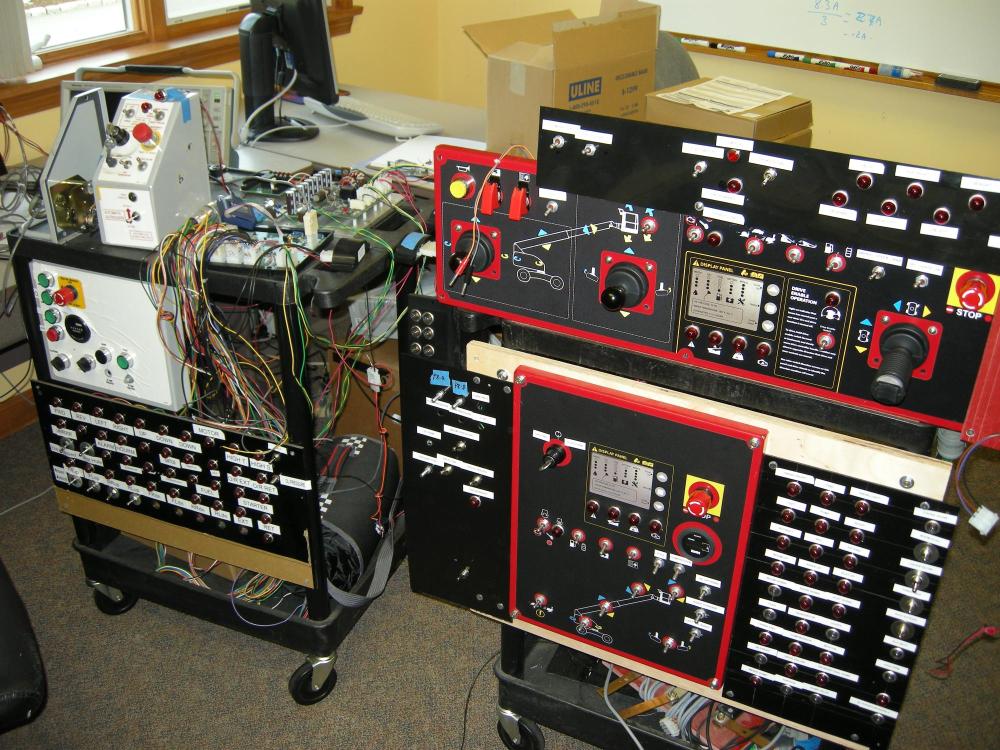
It’s quite important too that I am able to test the software I write – in years past we might have a loaned vehicle to test on, but more often now we’re developing before any vehicle has been built, and we have to make our own simulation rig. We build rigs on mobile carts which can be wheeled in and out of my office according to what project I’m working on – only so much space – but making a new rig takes time which we often don’t have, and the rigs can get complex and bulky, like this:

DSCN0783.JPG


So now, a new concept – build a “big rig” with enough switches, joysticks and lamps to simulate anything the customer might need!


“Template” files have been developed on a computer, which provide a location label for every switch and lamp – when a new project begins, these can be quickly edited, printed, and affixed temporarily to the big rig, to indicate the functions for the particular customer/vehicle. Much quicker than building a complete new rig!

This rig has a GP400 in the center, connected to potentiometers for varying voltage (the 9 knobs across the middle), with a bank of switch inputs below left and output indicator lamps below right. Inside, a mess of wires connects the GP400 to all those switches & lamps, and is also where I connect my computer to develop & test software.

Above, a removable section has a P440 module, connected to four control joysticks, and less but still many knobs, switches and lamps. The P440 module is designed for the platform control box of a vehicle – hence the joysticks.

At the bottom, a couple more joysticks and lamps, and loads more switches, provide inputs/outputs for a Matrix module (a low cost simple version of the P440), as well as CANbus joysticks (which have built-in electronics needing no separate module).

Connections down the side (not shown) allow any required particular combinations of modules to be quickly linked together – the whole “big rig” concept is to enable me to test more quickly (today, I often either finish the software untested while waiting, or have to delay the project); real world use of this “big rig” awaits final requirement details from the customer, but soon this’ll be in my office …