Today I headed back down to YarrowSport to watch a Randy Webb Pulley Party and get another dyno run on GBMINI (to see if the recent JCW upgrade upgrade offers any measurable improvement).
Lee, a friend and one-time MINI Peabody tech, came with me – first we went to the local Krispy Kreme where MINIs-Making-A-Wish was helping to launch a toy collection, and Steve, MINIs-Making-A-Wish maestro, was interviewed by the local TV station:


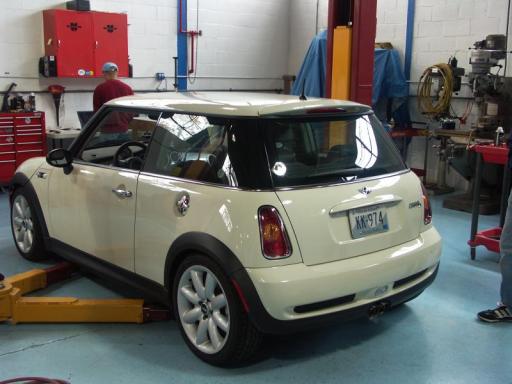
Steve had recently been at Randy Webbs Pulley Party, getting this air intake (and a pulley) fitted (he commented that it was now like driving a new car); so Lee & I headed over to YarrowSport to meet Randy. While we were there we watched a short-shift kit being installed on Marks Pepper White MCS – Mark already had a pulley, computer, exhaust and intake done by Randy at a previous event.
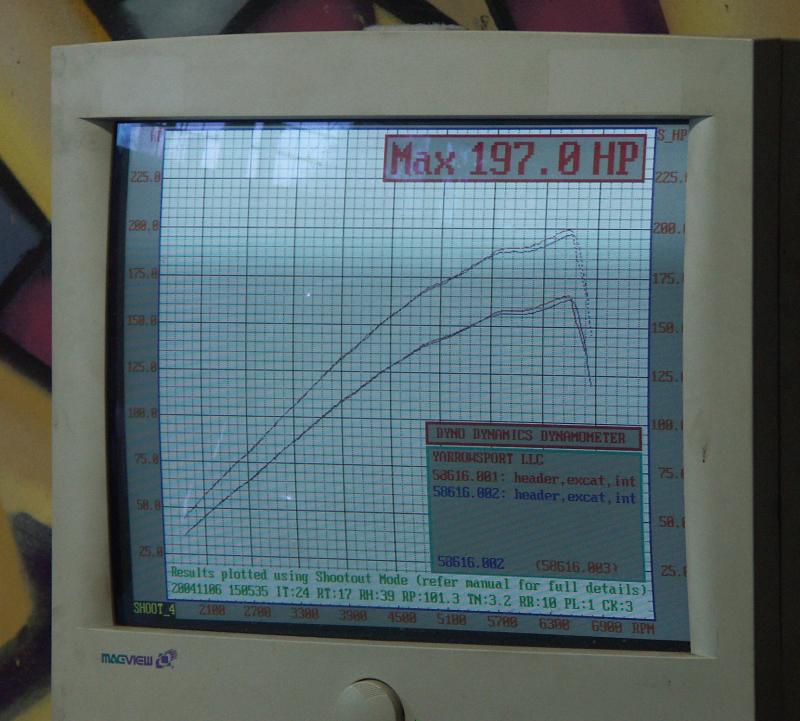
I met “Onasled” again – since the previous Dyno Day he has personally installed a pulley, air intake, computer, header, exhaust and intercooler! Wow! His first dyno run gave 197hp.
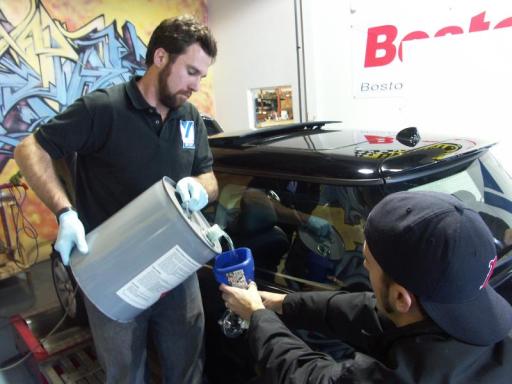
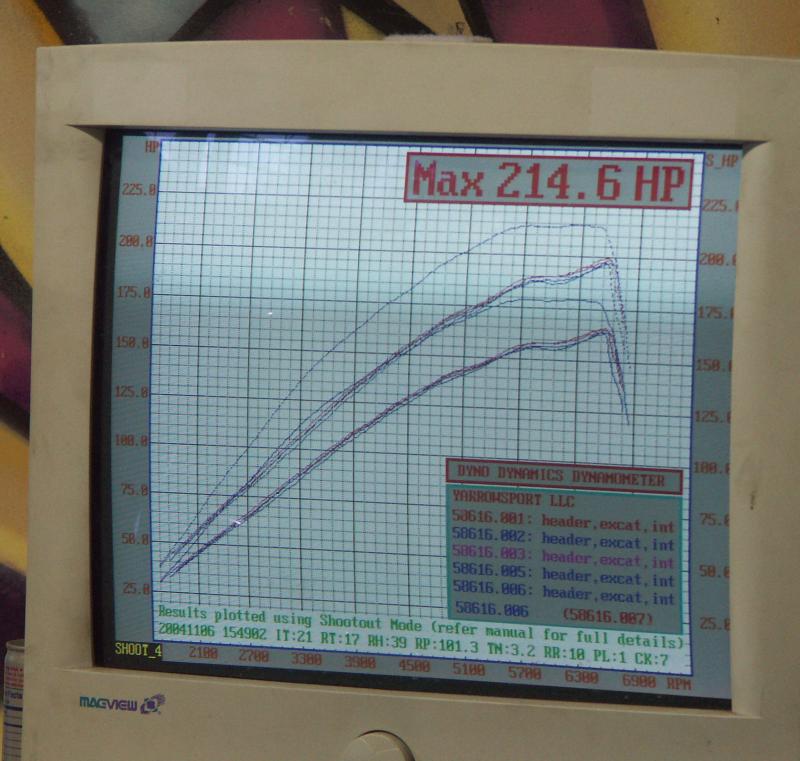
Once again Yarrow got creative, adding racing fuel to the car and then super-chilling the intercooler to get a highest reading of 214.6!


Eventually GBMINI went back on the dyno; Yarrow told me that the rig corrects for ambient temperature & humidity differences so it is apparently fair to directly compare the September run with todays run (unfortunately Yarrows printer had no ink!):


We can see on this plot that todays run shows an increase all the way up the rev curve showing a peak torque of about 186 compared with 177 – but the red line cuts in about 200rpm lower, so the peak hp shows only about a 4hp increase.
It looks like there should be about 6-8hp increase (maintained up the curve from about 3300rpm) and I don’t know if the red line is due to operation of the dyno, or a side-effect of the V39 engine update.
So we once again try to conclude some results:
The JCW upgrade upgrade seems to give about 10 lb-ft increase in torque, but the expected hp gain does not show on the above dyno run – apparently due to a lowered red line
A full aftermarket modded MINI can still beat the “210hp JCW”, by about 6hp.
Randy Webb is a great guy who can put together a very high performing package (all the top-performing MINIs at both Dyno Days were equipped with Randys Unichip/Pulley/etc packages.
That intercooler really does need to get cool to give good performance.
Yarrow needs to stock up on his printing supplies!
UPDATE: A close comparison of Onasleds and my plots shows that while his peak hp is better than the JCW, the JCW shows higher hp at lower “real world” revs:
| rpm | JCW | aftermarket |
| 2100 | 61 | 57 |
| 2700 | 86 | 80 |
| 3300 | 115 | 105 |
| 3900 | 137 | 132 |
| 4500 | 157 | 155 |
| 5100 | 171 | 171 |
| 5700 | 182 | 187 |
| 6300 | 185 | 194 |
| Peak | 193.7 | 197.0 |
UPDATE: here is a video of the TV coverage:
 M&I / GBMINI

Thurston Street is almost impossible to find (no street sign), so look for the “Paintball” sign at the intersection with Elmwood Ave.
Sounds like a great day. I would have been there but I had lunch with some co-workers in China Town!
My father had a M-Benz 300 Sl Gullwing from 1956 to 79 and when he wanted max performance he went to the Airport at BDL and filled up with 135 octane Av Gas the Gullwing had an ‘octane selector’ on the dash that would let you get the best out of the engine depending on the fuel avaiable (some places in the 50s you would be lucky to get 80 octane south of the border in Mexico) it would improve the 0 to 60 time by over 1.5 sec compaired to standard ‘hi-test’… then later on by the late 60s Sunoco for had a ‘almost race fuel’ available on their selector pumps that was almost as good as the av gas…
what do those 5 gal cans go for BTW?
I wonder what NO2 and CO2 on the intercooler would add to Onasled’s numbers… what is the engine good for in max ‘street’ tune? 260 280 hp? and how long will it last when pushed that high… Inquiring minds and all that 😀
Cheers,
~R~
Well a touch of Google show 3 places that sell it in Mass.
Massachusetts Interesting… and one of them is not far from the Cod!
Sunoco GTTM 100, which has the highest octane rating of any street legal fuel, is now available at selected retail locations. Sunoco GT 100 is designed for high performance street cars, muscle cars, classics, street rods, motorcycles, karts and marine applications. Sunoco GT 100 contains no metallic compounds to harm catalytic converters or oxygen sensors. It contains a comprehensive additive package for greater engine protection and reduced fuel system deposits as measured by the BMW test. Sunoco GT 100 is also compatible with virtually all two-stroke synthetic and mineral based motor oils.
Brad’s Service
817 Frank Street
Chicopee, MA 01020
(413) 592-5187
Gas Express
52 Tarkin Hill Road
New Bedford, MA 02740
(508) 995-0500
W. Harwich Sunoco
Tre. 28 & Division Street
West Harwich, MA 02671
(508) 432-4344
Randolph, some fine searching you did there 🙂
General note: A higher octane fuel will make no difference to the performance of your car unless either you get knocking with the fuel you are using, or (like Randolphs Dads old car) you have a mode to switch the octane rating – which allows the car to alter its timing.
The Unichip aftermarket engine computer does have an “A/B” mode switch so I guess you could have one of the modes loaded for high octane fuel.
Ian. I would bet that the difference in the lower hp of my car compared to yours in the lower rpms is due to my header. It’s about what you might expect with one I guess.
Randolph, I believe I paid Yarrow $5 A GALLON FOR THAT FUEL and I also believe it was 104 octane. He put the entire five gallons in and the tank then read just about full. My guess is that it was now about a 50/50 mix of 104 and 93, so I figure I’ve been running 98 octane all day today. Have to say that I feel absolutely no difference.
I do have the A and B map on my Unichip. Both seem to work equally well on the usual 93 octane. We switched them back and forth during the dyno runs, and the difference between the two was at most 1 or 2 hp.
The effect of the cooled air from the almost empty nitrous tank was just huge, 15HP! I hade posted on mini2 that I believe that my typical street HP might be somewhere around 210 to 217 in the cooler air. I bet that in summer it would be down around 197 to 200. I have also come to the conclusion that to get anything over 215-219, you would have to do head work and or cam.
Nice writeup Ian (and on motoringfile too). I love the comparison between JCW & others throughout the rev range…much more power at “real life” rpms. Should also translate to quicker acceleration times.
But what I haven’t seen from you is much mention of any difference in feel of the new upgrade. Plenty on MINI2 say it feels much quicker, better sounding, even more fun to drive…do you share this? That’s the most important part of shelling out the money, do you get extra “smile points” from the 04->05 upgrade?
Ian ask that I try and go into a bit more detail on my header comments, so I have given it some thought and have come up with the following comments.
Yes, it is somewhat common knowledge that a header might equal a loss of some HP in the lower RPM. I am not one to even try to completely understand why as I have many other hobbies besides just spending $$ on my MCS (smiley face inserted here).
The Dyno shows power from the car accelerating , in third gear I believe, from about 1700 rpm up to redline. Not what a header is designed for! A header is used for racing conditions where your RPMs are usually up in the upper middle to redline. Ian’s comparison shows my car trying to ‘catch up’ after some bogging down (almost unnoticeable on the street) in the very low RPM. I might bet that if the dyno started at 3000 rpm, after the car was steady that for a few seconds, that you would see the header doing it’s job and giving my car the edge.
Remember, Ian’s car has some JCW head work already installed. Head work is probably the second best thing you can do to the MCS after the pulley. My header is not serving a true purpose yet as the flow of the stock head is not what it should be. I installed the header with the thought that a new Webb head and cam were just down the road.
In looking at my Dyno printout, it seems that I have some problems that need addressing such as the lower redline and most of all that dip in power up in the 6000 range. I also would like to point out that the last two test were interesting. As we saw, the cold air blast over the intercooler added a WOPPING 15HP!. The last test just after this showed that the 104 octane was either not in the motor yet, or it made no difference since the dyno was back at 199. I would say that the higher octane had no effect on performance being that I beat on the car for two days afterwards and felt NO difference. I let the car run just about empty and just filled it with 93. The car felt more powerful this AM as it was about 38 degrees out.
INTERCOOLER, INTERCOOLER, INTERCOOLER! This is so obviously a KEY factor to better HP!
Josh,
I have not commented much on the feel of the JCW intake improvement because I am not sure how to evaluate what I feel.
There is an obvious improvement in general driveability but I am unsure if this is due to the JCW upgrade or due to V39.
I do not feel the “nitrous like kick” that others have reported when you reach 4500rpm – but I don’t often drive up near red line anyway so when I do, I have no before reference experience to compare the after experience.
Maybe you & I need to meet and switch cars for half an hour 🙂
Maybe we should. 🙂 I assume I’ll be seeing you at the rally this weekend anyway. If nothing else, I would like to hear it while revved above the 4500 while parked just to notice the intake noise. Before this I was intending to get the Dinan intake.
Not that it matters, I still fully plan on getting the upgrade, it’s just the price tag that is making me have to wait a while.
Wait… your car made 193.7whp on a DYNO DYNAMICS 4WD Lowboy HeartBreaker?
That’s close to 230bhp! That’s astounding! Those dynos aren’t very happy to hand out big numbers like that.