Wow – who wouldn’t buy a car that got such great mileage, even if it was a Honda Civic; qnd look at the quality of the “54 MPG” logo on the back of the car – GBMINI has nothing quite like this:


Meanwhile back in the real world, Leslie who runs MyAutoLog has updated GBMINIs fuelling data, to show an average of almost 27mpg since I got my third MINI – a little better than the average MCS, but not as good as the average MC:
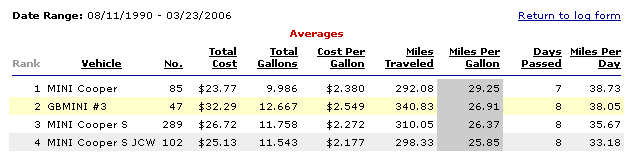
Of course MPG is heavily dependant on driving style and traffic conditions, but averaged over 85 MINI Coopers, 289 MINI Cooper S and over 100 JCW equipped MINI Cooper S, I think the “real world” figures for the cars are realistic, showing about 10% better fuel economy for the non-S engine.
I am impressed with all the work that Leslie has done, and really like MyAutoLog, except for one, to me, very significant detail:
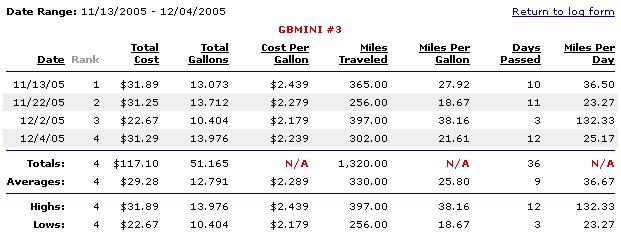
In the above data, you can see that on 12/2 I “short-filled” my tank (only putting 10.4 gallons in) prior to a trip – I’d driven 256 miles since the previous fill, giving me an MPG of 24.6.
After the trip, I filled the tank again, putting in 13.976 gallons (tank must have been quite empty!) and, on the trip distance of 397 miles, giving me an MPG of 28.4.
These figures are realistic, matching the typical MPGs for GBMINI#3 – in the colder weather I get below 25 MPG around town, but I can get 28-30 MPG on a run.
However, MyAutoLog allocates the distance driven to the fuel being burned while driving that distance. In one way this is sensible – you link the “miles with the molecules”.
But it gives incorrect tank-to-tank MPG figures – in the example above, my “short” distance of 256 miles is allocated to the normal full tank prior, of 13.712 gallons and giving a much-too-low MPG of 18.67; and then after my trip when I fill up again, the 397 miles is associated with the 10.4 gallons, giving a much-too-high MPG of 38.16!
Leslie & I have discussed this back and forth at length and we both remain on our own side of the fence. Leslie explains that not everyone fills their tank each time, so he never knows how much fuel was really used between fills – that may be true, but then his MPG calculation method is no better anyway, so why not do the correct calculations!
There is one special case where linking the latest fill to the previous one might be sensible – that is if trying to determine the effect of different grades/brands of gas on MPG. But even here, you would have to fill the tank to the same point every time, then you’d need to calculate the MPG based on distance covered since last fill, divided by latest fill quantity, and finally allocate the resulting MPG figure to the previous gas – allocating the distance to the previous fill is not the way to do it.
Of course Leslie points out that, over time, his method and mine give the same averages. True – but my method gives much more sensible tank-to-tank MPGs, making it easy to compare different driving styles / journeys / etc. For example when I drove in a very boring-but-fuel-efficient manner to British Invasion last year, my average got to just over 31 MPG (and the OBC showed 33 for the actual drive up 93N). But Leslies maths makes a claim of over 37 MPG!
Anyway, if you’re interested in your cars average MPG – especially in comparison to other MINIs and other cars – check out MyAutoLog, but don’t rely on the individual tank MPG figures (unless you always put the same amount of gas in the tank).


 M&I / GBMINI